Introductions

The Introduction of TDEC System

TDEC uses Microsoft SQL Server (2016) as the main database management system.

The system uses Microsoft ASP.Net and C# as the main development programming language and works with HTML5/ CSS3/ JavaScript for system development. All page designs are in line with the HTML 5.0 standard. This website standard conforms to Responsive Web Design (RWD). The RWD technique makes the web page automatically changes the width and the page configuration according to the size of the viewer's browsing device. All function operations can display the best reading mode at resolutions above 1440 x 900.

TDEC provides many useful functions for laboratories to efficiently manage and search extracts and compounds to facilitate drug research and development. These functions are constructed based on open-sourced and premium-services. In TDEC, there are many useful chemical database solutions are provided by ChemAxon and Chemicalize, including physicochemical properties calculation of molecules, similarity search of molecules, and online chemical drawing function.

The Architecture of TDEC System

TDEC consists of 10 management systems

Drug Management System is responsible for the drug data's registration and searching functions.

In addition, TDEC also provides a Cooperative Contract Agreement for drug samples. If members want to obtain physical drug samples, please read the description of the Cooperative Contract Agreement for drug samples in detail.

(1) The Items of Data Registration

TDEC provides a wide range of drug registered data items to allow members to register their valuable research results in the TDEC system. TDEC offers seven registered items, including (1) Basic Data Information, (2) Drug Source Information, (3) Biological Activity Database, (4) Chemical Structures, (5) Provider Information, (6) Physicochemical Properties Information, and (7) Whether Provide a Small Amount of Samples to the Center. Besides, there are a variety of registered fields listed under each major item.

Chemical Structures: This contains compound SMILES information, 2D structure (cdx) and 3D structure (mol/ pdb/ sdf) files.

Physicochemical Properties: This contains the data on the physicochemical properties of small molecules, including molecular weight, Solubility, pKa, LogP, LogD, etc.

Biological Activity Data: This contains information of anti-cancer activities, anti-inflammatory activities, anti-allergic activities, etc.

Provider Information: This contains the Chinese and English name of institution/ company, the name of faculty/ department, address, and telephone number (including country code and area code) of the drug sample provider.

Basic Data Information: This contains basic information of the drug sample, such as English name, stock, storage conditions, etc.

Drug Source Information: This contains drug source information, such as the provider of the drug source, the scientific name of the drug source, the part of the source material, etc.

Whether Provide a Small Amount of Samples: This contains that whether the member provides precious pure natural isolates, crude extracts or chemically synthesized derivatives of 1~2 mg samples to the Research Center for Natural Products & Drug Development (RCNPDD) of Kaohsiung Medical University (KMU) for preservation.

2.Data Registration by Batch Import

TDEC has the function of data registration by batch import, which can import multiple data at one time. The drug sample data sheet (xlsx) and file management system provided by TDEC facilitate members to operate a large number of drug sample data for registering and uploading. Material images (png/ jpg), references (pdf), compound 2D structure images (png), 2D structures (cdx), and 3D structures (mol/ pdb/ sdf) can be registered simultaneously via the function of data registration by batch import.

3.Registered Data Management System

TDEC provides registered data management function. Once members have registered their valuable drug information on this website, the information they have registered can be properly managed as the list and breakdown of individual drug samples through the registered data management system. Members can count how many pure natural isolates and crude extracts they have and look for more detailed information on the pure natural isolates or crude extracts that have been registered. In addition, the system will automatically distribute a TDEC ID to the approved drug sample, and this can facilitate the laboratory host to manage the drug samples. TDEC ID is given to each drug sample through TDEC system, and the drug sample entity of the laboratory is then properly managed. TDEC systematic management is used to quickly perform data display, search, modification and matching functions.

The information registered in the system can be modified by the members through the registered data management system before the TDEC approval. Once the TDEC has passed the approval, the detailed information cannot be modified. To update your modifications, please report back to TDEC via Contact Us.

(4) Registered Data Management System

TDEC provides members service functions such as query, management and matching of drug samples. If the member uses the TDEC system to query the drug sample data of interest and wants to further obtain the drug sample for related research or experiment, the drug sample owner should transfer part or all of the material to the demander. The two organizations have to sign the “Material Transfer Contract” or other contract with the same nature as the principle to specify the use and the related rights and obligations of the materials (pure natural isolates or crude extracts). This signing is not related to TDEC website. The members only have to thank TDEC by using the TDEC system for deriving relevant research results or publications (See Acknowledgements).

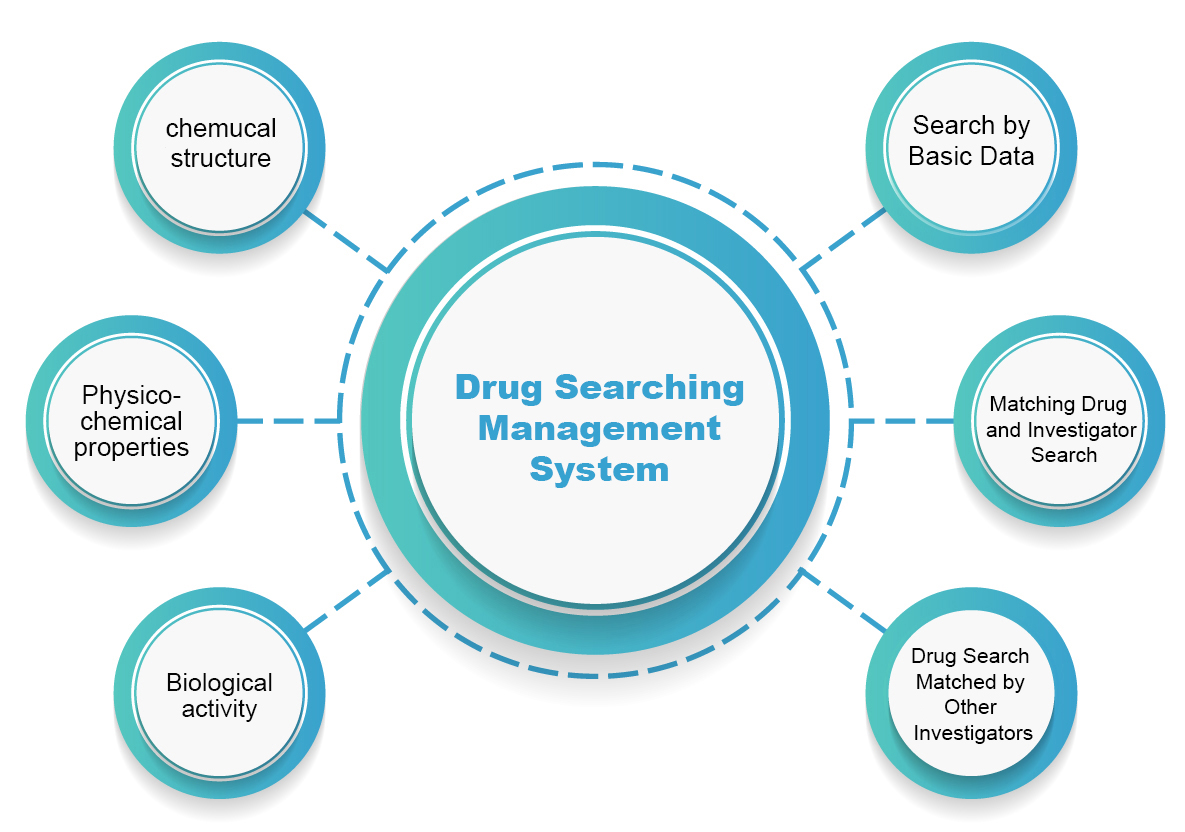
TDEC provides a full-featured drug searching management function to facilitate members to compare or search data in the system. There are six categories of searching function items, including (1) Search by Basic Data, (2) Search by Bioactivity Data, (3) Search by Chemical Structure, (4) Search by Physicochemical Properties, (5) Matching Drug and Investigator Search, and (6) Drug Search Matched by Other Investigators
(1) Search by Basic Data

Search by Basic Data on drug samples includes the query function of TDEC ID, Drug Category, Drug Sample Chinese/ English Name, CAS. No, IUPAC, Scientific Name, Plant Parts, and Extracting Solvent.

(2) Search by Bioactivity Data

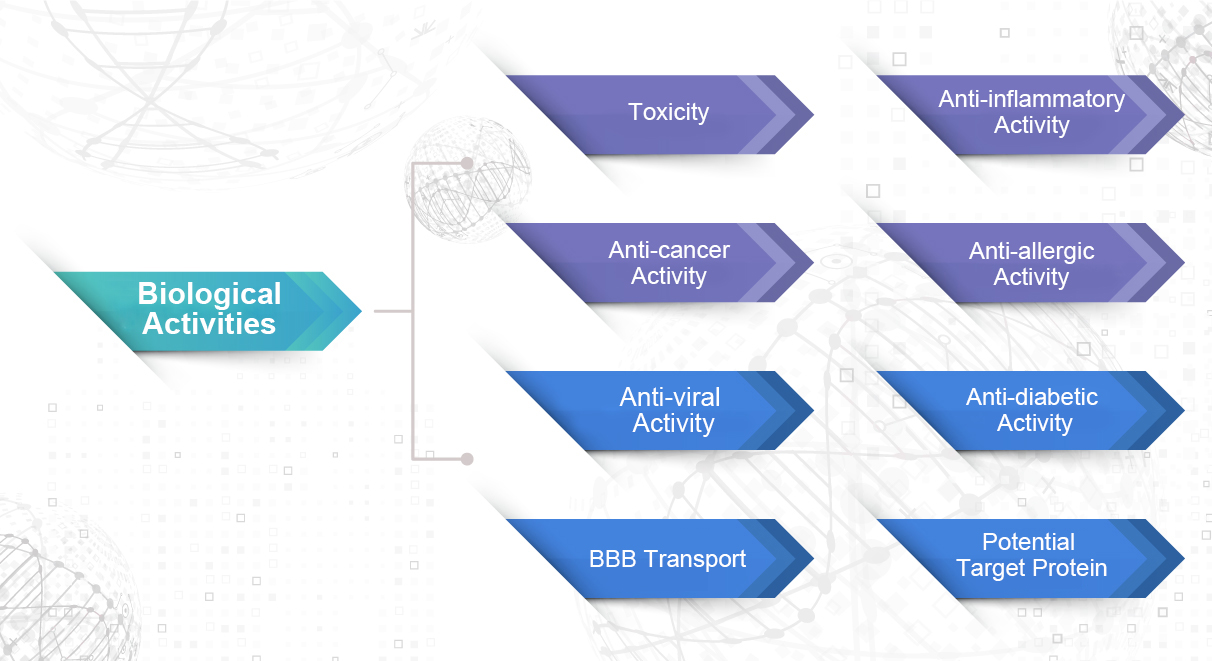
Search by Bioactivity Data function provide the following searching items, including: Anti-inflammatory Activity, Anti-allergic Activity, Anti-hepatitis Activity, Anti-diabetic Activity, Anti-cancer Activity, Anti-viral Activity, and BBB Transport Ability.
(3) Search by Chemical Structure

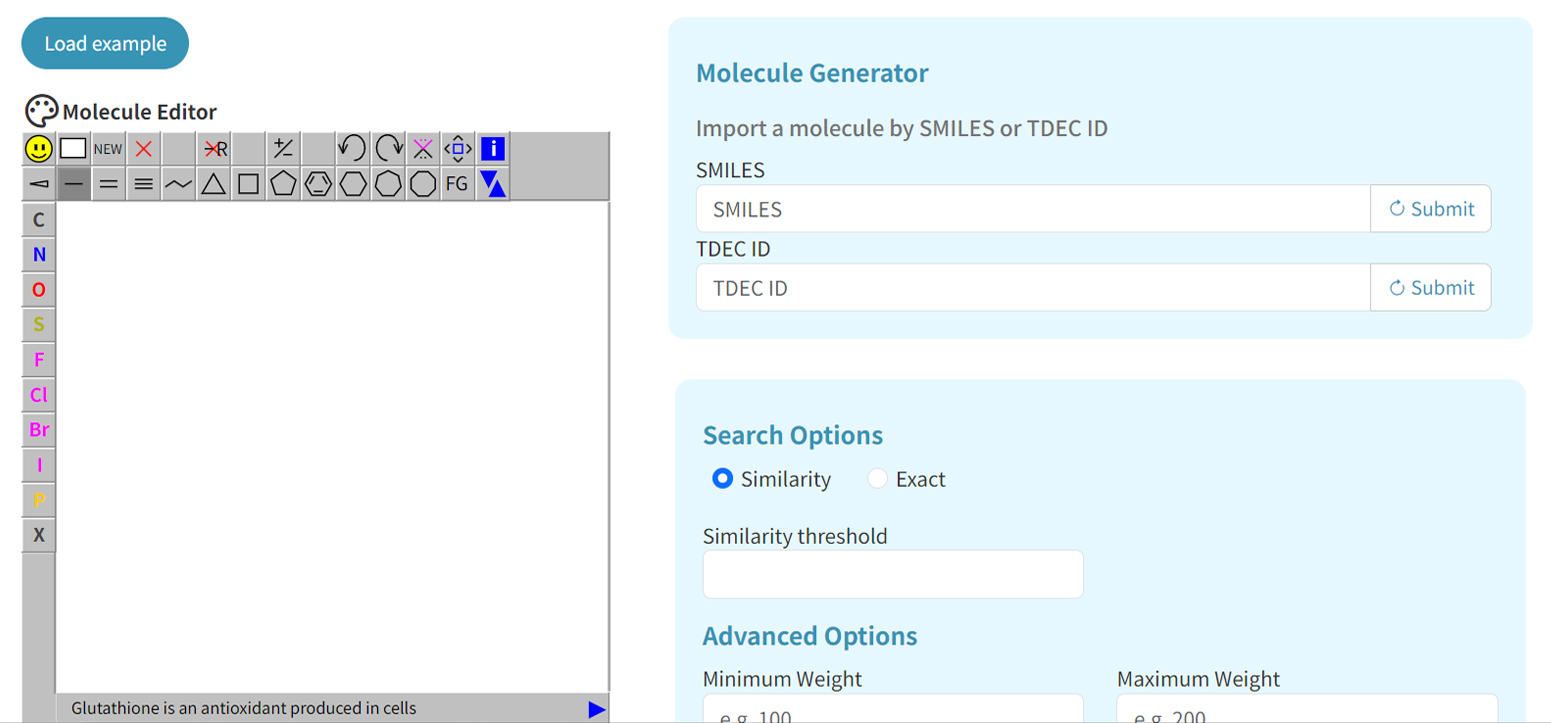
TDEC provides the online Marvin JS structural drawing board system and 3D preview service which are both developed by ChemAxon to facilitate the user to draw the chemical structure and operate the structure query function of the compound that user wants to query [1]. Marvin JS provides convenient and fast chemical structure drawing functions. In addition to drawing chemical structure graphics on the artboard, users can also import the files that you want to query directly from the outside via import function. Marvin JS also offers a number of chemical structure re-export functions, including two-dimensional (2D) chemical structure files and image files (png), such as cdx, mol, and sdf.

TDEC uses the Hosted Structure Searching Function developed by ChemAxon to provide TDEC members with structural similarity searching function, including: Similarity (similarity query, value 0.1~1.0), Substructure (substructure query), and Exact (complete structure query). In this function, TDEC searches the compounds in our database by SMILES notations, and list the searching results by the order of similarity. Firstly, members draw the structure they want to query on the online Marvin JS structure drawing board and then select the query type of structure (Similarity / Substructure / Exact) to perform the structural query. Subsequently, when members submit the compounds to our catalog, TDEC validates their SMILES notation first, and then upload our catalog to Chemicalize for utilizing structure search service to build database and index for our similarity search. In addition, TDEC provides eight query conditions for members to flexibly use the structural query together, including the basic information of the compound: TDEC ID, Name (English name), CAS, SMILES and InChI; Physiochemical Properties: Molecular Weight, Solubility Category and Lipinski's Rule of Five. It is convenient for members to quickly use the structural information to find the drug sample data they want.
(4) Physicochemical Properties Search

TDEC provides a Physicochemical Properties Search function that enables users to simultaneously retrieve both physicochemical and ADMET characteristics of small molecules.

In the Physicochemical Properties category, TDEC includes commonly used molecular descriptors such as the number of rotatable bonds (nRot), acid dissociation constant (pKa), and octanol–water partition coefficient (logP).

In the ADMET (Absorption, Distribution, Metabolism, Excretion, and Toxicity) section, the platform provides key pharmacokinetic parameters, including Caco-2 permeability, MDCK permeability, and human intestinal absorption (HIA).

Example:If researchers wish to screen for small molecules with high membrane permeability, good intestinal absorption, and low toxicity, the following search conditions can be specified:

The system will automatically list purified compounds that meet these criteria, enabling users to quickly identify potential drug-like candidates.

Through TDEC’s Physicochemical Properties Search function, researchers can efficiently perform multi-criteria filtering based on physicochemical and ADMET features, thereby enhancing the speed and precision of natural product–based drug discovery.

(5) Matching Drug and Investigator Search

TDEC provides Matching Drug and Investigator Search function. The system keeps the individual matching and searching records once members make the drug and investigator search

(6) Drug Search Matched by Other Investigators

TDEC provides Drug Search Matched by Other Investigators function. The system keeps the matched records once other investigators make a search of your drug.

TDEC provides physicochemical and ADMET (Absorption, Distribution, Metabolism, Excretion, and Toxicity) data for registered chemical compounds. These features are predicted using computational tools such as Open Babel, RDKit, and ADMETlab 3.0, covering key molecular descriptors including molecular weight, Lipinski’s Rule of Five, and rotatable bond count, as well as essential pharmacokinetic parameters such as Caco-2 permeability, MDCK permeability, and human intestinal absorption (HIA).

When a member submits small-molecule data to the TDEC platform, the system automatically calculates and returns the compound’s physicochemical and ADMET feature values to the front-end sample information page after administrative review and approval. These results are made available for member queries and further analysis.

The TDEC system aims to provide researchers with comprehensive predictive data on small-molecule physicochemical and ADMET properties. Such information serves as an important reference for assessing compound drug-likeness during the drug development process, thereby enhancing both the efficiency and success rate of pharmaceutical research.

The purpose of this system is to calculate the physicochemical properties of small molecules of pure natural isolate, as a useful information for drug development. For example, the water solubility characteristics of small molecule is an important key factor in the development of new drugs.

TDEC uses an Investigator Matching Management System for drug sample matching, which means using the Internet to quickly link information between drug sample providers (providers) and researchers or between drug developers (investigators). This can increase the opportunities for joint development of drugs in an interdisciplinary and cross-regional manner, and accelerate the development of new drugs. Its purpose is to bridge the information and resources between drug sample providers and researchers through the TDEC resource sharing platform, and provide an effective research cooperation pipeline for drug development experts and scholars from various fields.

The benefits of TDEC matching function are to improve the exposure of drug samples, increase the possibility of interdisciplinary and cross-regional cooperation, effectively integrate research results, reduce the waste of research resources, and accelerate the speed of new drug development research, as the biggest goal and purpose.

For example, when a member (applicant) uses TDEC to search for an interesting drug sample data, the matching function can be used for requesting. By pressing a button, the system will automatically send an e-mail to the drug sample provider (provider). The e-mail clearly let the provider know that other members are interested in the drug sample data and want to learn more details or have the willingness to cooperate. The provider can assess the feasibility of the cooperation according to the current situation, and then reply to the applicant according to the contact information provided by the media, that is, completing the online drug sample matching function.

TDEC Statistical Management System provides members with integrated data insights across three major categories: (1) Physicochemical Properties, (2) ADMET Properties, and (3) Dataset Statistics.

(1) Physicochemical Properties : This section includes statistical analyses of molecular features such as Lipinski’s Rule of Five, molar mass, and logP. These metrics help users quickly understand the overall physicochemical distribution of compounds.

(2) ADMET Properties : This module covers key pharmacokinetic parameters such as Caco-2 permeability, MDCK permeability, and human intestinal absorption (HIA). The aggregated data reflect compound drug-likeness and are valuable for early-stage drug development assessments.

(3) Dataset Statistics : This section presents key metrics, including quantitative statistics on drug samples, physicochemical properties, and bioactivity from both crude extracts and purified compounds, along with member and matching statistics. Together, these indicators offer a comprehensive view of resource integration and utilization across the platform.

Through these statistical insights, users can gain a clear understanding of TDEC’s key functions, data resource distribution, and ongoing developments in the integration of natural product and drug-related information.

You can use TDEC's service resources or functions after registering as a TDEC member. You can complete the registration online without any registration fee. After the TDEC administrator has reviewed the integrity of the member registration information, an e-mail member approval notice will be issued to you for being a TDEC member.

Creat a account

Unit Management System is the TDEC system management function (background), and its main purpose is to manage the information headings of the TDEC unit outlines.

Frequently Asked Questions(FAQ) Management System (background) provides Q&A information for members.

Message Management System is a TDEC system management function (background), which is mainly used to manage the content of TDEC website units.

It is a channel for TDEC members to give feedbacks and suggestions for the Center or this website.

References